
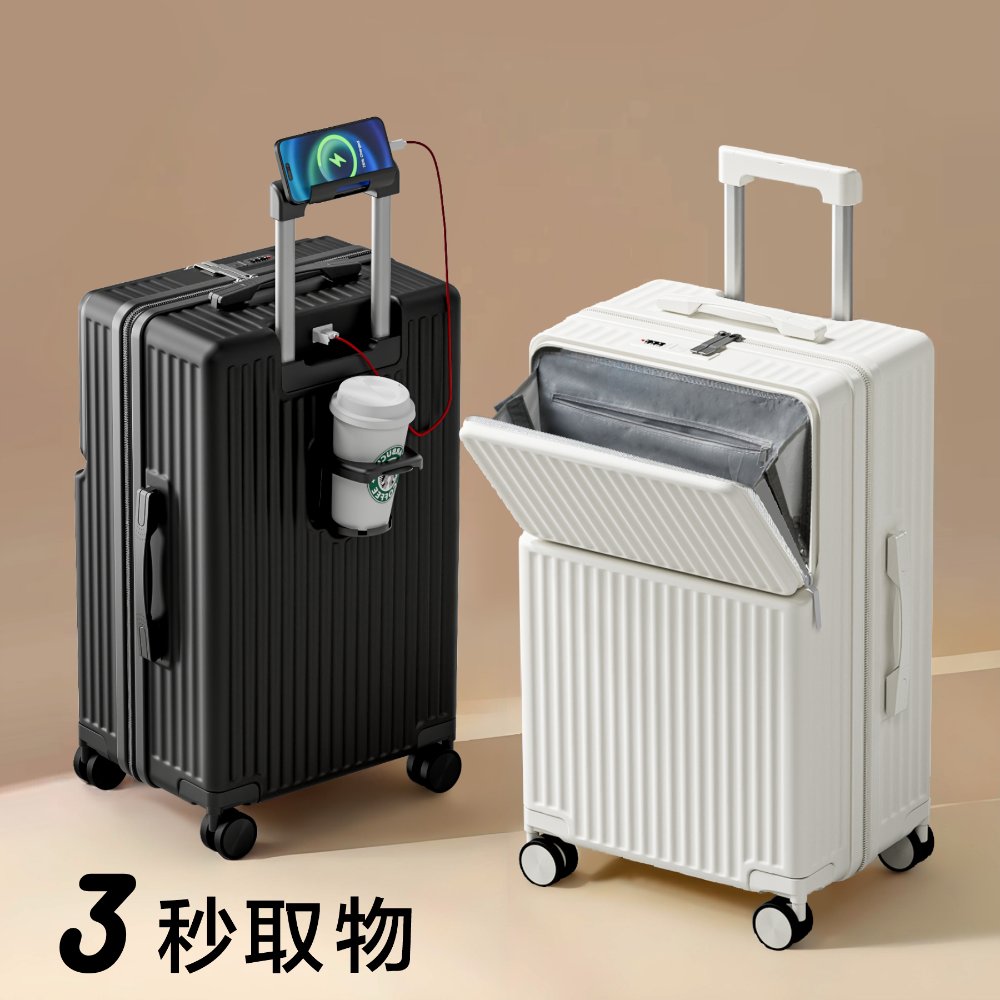
Define the front opening by its panel boundary, opening direction, closure path and destination compartment before approving a carry-on quotation. Ask for closed and open views of the same identified variant, with the relevant areas marked. Keep accessory inclusion, dimensions and any performance claims in separate confirmation fields so that an attractive photograph does not become an ambiguous purchasing specification.
Turn the product name into a precise access question
A request for front-opening luggage can describe several different buyer expectations. One buyer wants access to an outer pocket. Another expects an opening into the main packing space. A third is concerned with the appearance of the front panel when the case is closed. A supplier can answer all three with the same general catalogue photograph unless the RFQ distinguishes them.
Hangyue’s catalogue names a Front-Opening Carry-On Luggage with Silent Wheels product. Use that reference to identify the item you want to discuss, then ask which opening arrangement belongs to the quoted version. The catalogue name does not establish wheel-noise evidence, airline acceptance or the precise contents of an order. Those require their own written confirmation when relevant.
Establish the front before drawing an opening boundary
Choose a repeatable viewing orientation. For example, ask the supplier to show the case standing upright with the pulling handle behind it, then identify the surface being called the front. This is an instruction for documenting the sample, not an assumption about how every model is constructed. Retain the unmarked photograph alongside the annotated copy so that a drawing cannot hide a difference between versions.
Mark the complete boundary of the opening panel and the part that remains attached when it opens. Ask the supplier to indicate where the closure starts and ends and where the panel moves. If the image does not show these details, request a closer view rather than guessing from a seam, decorative line or reflection. The response should connect each annotation to the same supplier item reference.
Compare the information each quotation actually supplies
A quotation becomes easier to compare when both suppliers answer the same access questions. A general picture may identify a style but leave the opening function unresolved. A matched closed-and-open pair can answer the panel question while still leaving the internal compartment unclear. Record the remaining gaps instead of treating a longer attachment list as more complete evidence.
Decision field | Ask the supplier to show | Keep in the approval record
Front orientation | The agreed face of the upright case | An unmarked orientation reference
Panel boundary | The full edge of the opening panel | An annotated view tied to the item ID
Opening movement | The same panel in its open position | Which edge or connection remains attached
Access destination | The compartment reached through that opening | Whether the requested access is confirmed
Quoted variant | The version represented by all submitted views | The supplier reference and quotation revision
Separate the front-panel function from pictured extras
Catalogue scenes can show a phone, a drink, a small case or other accessories around the luggage. These details can help you formulate questions, but they do not prove that every item is included or that an illustrated function has been verified. Put each requested accessory on the inclusion schedule and ask whether it is supplied, optional, pictured for context or excluded.
Keep an access-time statement separate from the visual opening approval. Likewise, do not turn charging imagery into an electrical specification. If a feature matters commercially, ask for the exact supplied components and applicable supporting information before considering the claim for your own sales copy. The front-panel drawing can be approved while these additional questions remain explicitly unresolved.
Review a sample against the marked reference
When a sample is requested, identify what the buyer will compare. The panel outline, opening direction, closure placement and compartment reached should correspond to the accepted reference. Ask the supplier to identify any sample variation before dispatch. A different colour sample may be useful for some decisions, but the supplier should explain which construction details it represents and which remain unconfirmed.
Record observations without extending them into an unsupported performance conclusion. Seeing the panel open establishes the observed arrangement; it does not establish durability or a load rating. If dimensions are needed, request a drawing that identifies the measurement points and the condition of the case. Airline or retailer limits should be assessed against the buyer’s current requirements rather than inferred from the term carry-on.
• Identify the quotation and sample versions before reviewing the opening.
• Match the annotated panel to the same visible case in every view.
• Record accessory and compartment questions separately from appearance approval.
• Return unexplained differences for confirmation before accepting a revised reference.
Close the enquiry with a bounded approval statement
A useful decision states exactly what has been accepted. The buyer might accept the marked front-panel arrangement for the identified variant while requesting further confirmation of the compartment lining or accessory schedule. This is more actionable than an unqualified picture approval because the supplier can see which part of the enquiry remains open.
For a reorder, attach the accepted drawing and its revision rather than relying on a product name alone. Ask whether the quoted item still matches that reference and require any proposed change to be identified before the order is finalized. Keeping the opening record separate from price, packing and claim evidence makes later comparisons easier without pretending that one visual approval covers the entire product.
Frequently asked questions
Does front-opening mean access to the main compartment?
That should be confirmed for the specific item. Request an open view showing the destination compartment and ask the supplier to describe the connection. A front-panel outline alone does not establish what is accessible behind it.
Can a single catalogue photograph support an RFQ?
It can identify the product reference and start the enquiry. Approval normally needs the additional views required to resolve your particular opening questions. Keep unanswered points visible instead of interpreting hidden construction from the photograph.
Does the carry-on label confirm airline acceptance?
No airline acceptance is established by this guide or the catalogue label. Request the relevant measurements and compare them with the buyer’s current airline, market and retailer requirements. Record how protruding components are included in those measurements.
Should pictured accessories be included automatically?
No. List the accessories the buyer wants and obtain a separate inclusion decision for each. The supplier should distinguish supplied components from optional items or scene props so that the quotation and sample contents can be reconciled.
Product and contact references
Catalogue reference: confirm matching item: https://hangyueluggage.com/product/front-opening-carry-on-luggage-with-silent-wheels/
Related catalogue reference: https://hangyueluggage.com/product/hard-shell-travel-suitcase/
Contact Hangyue Luggage: https://hangyueluggage.com/contact/
Hangyue Luggage blog: https://hangyueluggage.com/blog/